Getting ready for California SB 253’s November 10 reporting deadline
With the initial reporting deadline under SB 253, California’s greenhouse gas emissions reporting law, set for November 10, 2026, this client update provides an applicability and compliance roadmap for companies based on CARB’s initial regulations and other guidance and instructions and a status update on the legal challenge to SB 253 and 261 pending in the Ninth Circuit. We will update this roadmap to reflect any late-breaking legal developments.
Overview
Absent last-minute legal developments, companies that are in scope under California’s greenhouse gas (GHG) emissions reporting law, SB 253, will be required to make their initial filings by November 10, 2026. This client alert provides a roadmap for companies for complying with the initial filing requirements. It draws on SB 253, CARB regulations governing the 2026 reporting cycle, which took effect on October 12, 2026 (the CARB Regulations),1 and other instructions and guidance issued by CARB, including its September 1, 2026 Guidance for SB 253 2026 Reporting Submittals (Reporting Guidance) and voluntary 2026 Report Intake Platform. For this initial reporting cycle, CARB has adopted a transitional approach that includes enforcement discretion, flexibility in submission formats, and acceptance of certain existing Scope 1 and Scope 2 emissions data. Companies should assess whether they are subject to the law and what information to submit, including whether a statement of non-reporting is appropriate. This framework applies only to the 2026 reporting cycle; CARB is developing requirements for 2027 and later years through a second rulemaking. We also provide an update on the legal challenge to SB 253 and 261 pending in the Ninth Circuit.
1 Cal. Code Regs., tit. 17, §§ 96070–96077. Note that the CARB Regulations and other guidance provided by CARB appear to offer flexibility to companies not reflected in the statutory text (framed as “enforcement discretion”) in certain respects. We have assumed that CARB will administer and enforce SB 253 consistent with the CARB Regulations and its guidance.
The latest on the Ninth Circuit litigation
- SB 253 and SB 261 are the subject of a lawsuit brought in federal court in California by business groups contending that the laws compel speech in violation of the First Amendment. The district court denied the plaintiffs’ motion for a preliminary injunction in August 2025 and the plaintiffs appealed to the Ninth Circuit.
- In November 2025, the Ninth Circuit enjoined enforcement of SB 261 pending its decision; that injunction does not apply to SB 253, which remains in effect. While the appeal has been fully briefed and argued since January 2026, no decision has been issued to date.
- In an October 8, 2026 filing with the Ninth Circuit, the plaintiffs noted the urgency of the need for an injunction given the looming November 10 deadline and the “imminent threat of state sanctions if they fail to engage in compelled speech on controversial matters.”
- A ruling by Ninth Circuit could put some or all of SB 253 on hold, leave SB 253 undisturbed lift the existing stay against SB 261.
- However, unless and until a court enjoins SB 253, the November 10 deadline stands, and companies should continue preparing to meet it while monitoring the litigation.
Determining whether a company is in scope
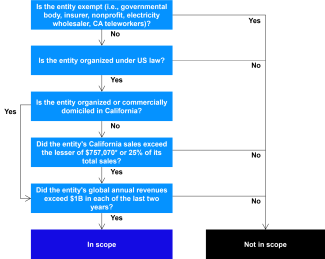
The above decision tree provides a visual guide for determining whether a company is subject to SB 253 (referred to as a “reporting entity” under the statute).
According to the CARB Regulations, a company is a reporting entity and subject to SB 253 if it meets all three of the following criteria:
- it is a business entity formed under U.S. law;
- its total annual revenues exceed $1 billion; and
- it does business in California.
Under the CARB Regulations, the terms “revenues” and “doing business in California” are defined by reference to the California Revenue and Taxation Code (the Tax Code) as discussed below.
Applying SB 253's scope criteria to affiliated business entities
The CARB Regulations provide that applicability is determined on an entity-by-entity basis. For a business comprising a group of affiliated entities or an investment fund with multiple investee or portfolio companies, this means that the above criteria are applied to each discrete legal entity within the overall structure. Entities that meet the criteria are in scope. A parent company or a shareholder that does not itself meet these criteria is not in scope merely because its subsidiary or an entity in which it holds equity meets them. As discussed in our prior client update, this question was a matter of uncertainty throughout CARB’s rulemaking activities, which was resolved in the CARB Regulations.
Determining whether a company is “doing business in California”
The CARB Regulations adopt a two-prong test drawn from the Tax Code. A company is “doing business in California” if it:
- is actively engaging in any transaction for the purpose of financial or pecuniary gain or profit; and
- either (a) is organized or commercially domiciled 2 in California, or (b) has California sales exceeding the lesser of an inflation-adjusted threshold ($757,070 for 2025) or 25% of its total sales, determined under the Tax Code sales-assignment rules.
For the sales test, “sales” has the same gross-receipts meaning used elsewhere in the Tax Code, and includes sales by an agent or independent contractor. As noted above, sales are assigned to California under the Tax Code’s sales-assignment rules. Accordingly, for many companies, the California sales reported on their California tax return will be a natural starting point for this analysis, but the regulatory text is ultimately dispositive. For example, the CARB Regulations provide that wholesale sales of electricity that occur in interstate commerce do not count toward California sales. The CARB Regulations do not extend this carve-out to other commodities.
Finally, as noted above, the “doing business in California” determination “is evaluated at the individual business entity level.” This means that sales should not be aggregated among affiliated entities, and one entity’s sales should not be attributed to an affiliate based on their corporate relationship.
2 In general, an entity is “commercially domiciled” at the principal place from which the trade or business of the entity is directed or managed.
Calculating “revenues”
The CARB Regulations define “revenue” as “gross receipts” under the Tax Code. Gross receipts are “the gross amounts realized … on the sale or exchange of property, the performance of services, or the use of property or capital (including rents, royalties, interest, and dividends) in a transaction that produces business income,” without reduction for “the cost of goods sold or the basis of property sold.”
Three features of this definition deserve emphasis:
- It is a worldwide measure. Gross receipts are not limited to California-source or even U.S.-source amounts; the statutory definition expressly reaches transactions whose income would be recognized under the Internal Revenue Code “if the transaction were in the United States.” Thus, a company whose California sales are a small share of its business can therefore be in scope if its global gross receipts exceed $1 billion and it meets the “doing business in California” test.
- It is a gross, not net, measure. Gross receipts are not reduced by cost of goods sold or the basis of property sold. They also include items such as interest, dividends and the proceeds of property sales. A company’s gross receipts may therefore substantially exceed the revenue reported in its financial statements.
- It is measured entity-by-entity. As noted above, revenue “is evaluated at the individual business entity level,” and intercompany transactions between business entities in the same combined reporting group are excluded. A subsidiary’s revenue is therefore not aggregated with or attributed to its parent (or vice versa), even if the entities file a combined or unitary California return.
As with sales, CARB guidance directs companies to specific line items in their California tax filings as a reference point for gross receipts:
- Schedule F, line 1a of Form 100 (corporations) or Form 100S (S corporations);
- line 1a of Form 565 (partnerships); and
- Schedule B, line 1a of Form 568 (LLCs).
The same caveat above applies here: the tax filing line item is a starting point but is not dispositive. CARB has described tax filings as “[t]he common-sense approach for establishing and confirming entities’ revenue amounts.” In the Summary of Comments and Agency Response issued by CARB in May 2026, however, CARB cautioned that while these line items “will serve as a primary reference point” for many entities, tax filing requirements and form structures vary, and “a single line item may not be determinative for every entity.”
Under the CARB Regulations, an entity’s revenue “shall be determined by the lesser of the entity’s two previous fiscal years of revenue.” In practice, an entity is in scope if its revenue exceeds $1 billion in both of those years. According to CARB, the two-year lookback is meant to “reduce the effect of significant year-to-year fluctuations or one-time revenue spikes.” CARB declined to apply the same lookback to the California sales test.
Exempt entities
The CARB Regulations expressly exempt the following categories of entities:
- federal, state, and local government entities, and companies majority-owned by government entities;
- entities subject to regulation by the California Department of Insurance or in the business of insurance in any other state;
- nonprofit and charitable organizations that are tax-exempt under the Internal Revenue Code;
- entities whose only activity in California consists of wholesale electricity transactions that occur in interstate commerce; and
- entities whose only business in California is employee compensation or payroll expenses, including teleworking employees.
The content of the November 2026 submission
For this cycle, the basic statutory reporting requirement under SB 253 covers two categories of the reporting entity’s GHG emissions:
- Scope 1 emissions: all direct GHG emissions from sources that the reporting entity owns or directly controls, regardless of location, including fuel combustion activities.
- Scope 2 emissions: indirect GHG emissions from electricity, steam, heating or cooling that the reporting entity purchases or acquires and consumes, regardless of location.
However, CARB has not prescribed a mandatory format for the report due November 10, 2026, and has provided reporting entities with considerable flexibility. Although CARB provided a draft template for Scope 1 and Scope 2 reporting in October 2025, it is not mandatory for this cycle. CARB has indicated that reporting entities can also comply by submitting Scope 1 and Scope 2 data contained in existing reporting done under voluntary or regulatory frameworks. At a minimum, the CARB Regulations provide that a reporting entity’s reporting obligations turn on its data collection practices as of December 5, 2024:
- Reporting entities that possessed or were collecting Scope 1 or Scope 2 emissions information on or before December 5, 2024, are required to report the Scope 1 or Scope 2 emissions data that can be determined from that information.
- Reporting entities that did not possess and were not collecting Scope 1 or Scope 2 emissions information on or before December 5, 2024, are required to submit a statement on letterhead indicating that they are not providing data for this reason.
While the option to submit a statement in lieu of a report may provide welcome relief to some reporting entities, companies should thoroughly review what data they were collecting or possessed as of December 5, 2024 – and their public statements regarding the same – before deciding to avail themselves of this option. In addition, CARB has indicated these statements will be made publicly, so companies should also consider whether such a statement conflicts with their current public messaging regarding sustainability. Reporting entities that use either option will still be assessed CARB’s annual fee.
Although SB 253 calls for limited assurance of Scope 1 and Scope 2 emissions beginning in 2026, CARB has stated that, as a matter of first-year enforcement discretion, it is not mandating limited assurance for 2026 submissions. Reporting due in 2027 (and beyond) is expected to require reporting entities to obtain limited assurance of their Scope 1 and Scope 2 emissions.3
3 See CARB, Guidance for SB 253 2026 Reporting Submittals 4 (Sept. 1, 2026); Cal. Health & Safety Code § 38532(c)(2)(A)(i)(II), (c)(2)(F)(ii)-(iii).
Determining which fiscal year’s emissions data should be reported
The period covered by the report depends on the company’s fiscal year-end. Under the CARB Regulations, entities whose fiscal year ends on or before February 1, 2026 report data from the fiscal year ending in 2026; entities whose fiscal year ends after February 1, 2026 report data from the fiscal year ending in 2025. A calendar-year company, for example, reports fiscal year 2025 data. However, entities whose fiscal year ends after February 1, 2026, may elect to report their fiscal year 2026 emissions data if available.
Relying on parent company filings
The CARB Regulations provide that reports “may be consolidated at the parent company level” and that, if a subsidiary qualifies as a reporting entity and “the parent company chooses to consolidate reports, the subsidiary is not required to prepare a separate report.” Whether an entity counts as a “parent” or a “subsidiary” depends on the “direct corporate association” provisions of California’s Cap-and-Invest Regulation:
- Subsidiary. A subsidiary is a business entity that another business entity owns or controls through a direct corporate association. A subsidiary may be a separate legal entity, but it is under the parent’s control, which can influence its operations, management or financial decisions.
- Parent. A parent is a business entity that owns or controls another business entity through a direct corporate association. The indicia of ownership or control are the ones set out in the subsidiary definition (17 CCR § 96072(a)(10)).4
Two important notes regarding parent consolidation:
- The parent does not have to be in scope. Consolidation depends on two things: (1) the subsidiary being a reporting entity and (2) the parent choosing to consolidate. This matters for groups with a non-U.S. ultimate parent, because only entities formed under U.S. federal or state law can be reporting entities. Nonetheless, a consolidated, non-U.S. parent report satisfies the SB 253 reporting obligations of in-scope subsidiaries.
- Consolidation does not impact a reporting entity’s fee obligation. Each in-scope subsidiary is still assessed its own annual fee. However, “fee payments may be consolidated at the parent company level,” and if the parent consolidates payments, the subsidiary doesn’t have to pay separately.
4 The regulation does not pick up all of § 95833. Only the direct corporate association tests in § 95833(a)(1)-(3) and (a)(5) apply for consolidation purposes (17 CCR § 96072(a)(16)). Groups with multitier structures should confirm that each link between the consolidating parent and each in-scope subsidiary meets one of those subsections.
How to submit the report
The CARB Regulations set November 10, 2026, as the reporting deadline. CARB staff has proposed November 10 as the annual deadline for 2027 and later years. On September 1, 2026, CARB released a voluntary 2026 Report Intake Platform that companies may use to provide their contact information and submissions. Use of this platform is not mandatory. Companies may also email their submissions to climatedisclosure@arb.ca.gov.
Fees and penalties
- Fees. The CARB Regulations impose a flat annual fee on each in-scope entity, calculated by dividing CARB’s program implementation costs (including a 10% contingency and repayment of program debt) between SB 253 and SB 261 and across the entities subject to each law. CARB will issue its first fee determination notices by December 10, 2026, and annually thereafter, with payment due within 60 calendar days of the notice date. Each in-scope entity will receive its own notice, though a parent may consolidate the fee payments of its in-scope subsidiaries. Late payments accrue late fees, in addition to any penalties, and each calendar day of nonpayment constitutes a separate violation. Entities must also retain California tax records demonstrating that they meet the revenue and doing-business thresholds for five years and provide them to CARB upon request.
- Penalties. The CARB Regulations authorize penalties in accordance with SB 253 capped at $500,000 per reporting year. In assessing penalties, CARB must consider all relevant circumstances, including the violator’s past and present compliance and whether and when it took good-faith measures to comply. Separately, the CARB Regulations establish fee-enforcement provisions under which each calendar day of a violation constitutes a separate offense, and violations may be enjoined.
Preparing for 2027 and beyond
The 2026 cycle is, by design, an easy one. CARB’s Reporting Guidance states that it “applies only to the first reporting cycle (i.e., 2026 reporting),” and the CARB Regulations limit their alternative reporting options to the report due November 10, 2026. CARB is now engaged in a second rulemaking to set requirements for 2027 and later years, covering accounting methodologies, deadlines, assurance and reporting formats, aiming to release proposed regulatory text later this year and submit it to CARB for approval by the end of the year. Accordingly, companies should consider the following as they start to build the data collection processes they will need for 2027, when the flexibility offered by CARB for this reporting cycle will no longer be available:
- Expect more proscriptive Scope 1 and Scope 2 reporting standards. As noted, the alternative reporting options and report format flexibility available this year are not expected to be available in subsequent years. At its most recent public workshop regarding the second rulemaking, CARB outlined reporting standards that hew more closely to the GHG Protocol.
- Scope 3 reporting begins in 2027. Consistent with SB 253, CARB is planning to require Scope 3 emissions reporting starting in 2027 in its second rulemaking. While the contours of those requirements are under development, CARB’s most recent proposal would limit Scope 3 reporting to certain specified categories for 2027.
- Assurance requirements are scheduled to go into effect. SB 253 calls for CARB to mandate limited assurance for Scope 1 and Scope 2 disclosures beginning in 2026 and reasonable assurance beginning in 2030. Although the CARB Regulations waive this requirement for 2026, we expect that CARB’s second rulemaking will reflect the statute’s assurance requirements starting in 2027.
This communication, which we believe may be of interest to our clients and friends of the firm, is for general information only. It is not a full analysis of the matters presented and should not be relied upon as legal advice. This may be considered attorney advertising in some jurisdictions. Please refer to the firm’s privacy notice for further details.