UK Takeovers: Mid-year recap of developments and key trends
This update recaps developments and key trends in UK takeover activity over the last six months.
Takeover offers: Developments
- The City of London Law Society (CLLS) and the Law Society of England and Wales (Law Society) published updated guidance notes. Following recommendations made by a joint working party of the CLLS and the Law Society, the CLLS published online three updated guidance notes dated January 30, 2026, relating to Conditions to and certain further terms of the offer, Further terms of the offer and Admission conditions.
- Conditions and Further terms. These two notes, originally issued in June 2021, provide illustrative examples of the approach that could be taken to the structure and drafting of certain aspects of the conditions and further terms to a contractual offer. The January 2026 updates insert an introductory note clarifying that neither note includes language or provisions intended to address a situation where the target company has shareholders that are subject to UK or other sanctions regimes.
- Admission conditions. This note provides illustrative examples of conditions that could be used for a scheme of arrangement or contractual offer where consideration shares are admitted to listing on the commercial companies listing category and to trading on the LSE Main Market. It supersedes the previous version issued in April 2011 and reflects the changes to the UK listing regime as a result of which an issuer is no longer required to apply to the FCA for admission of further issues of shares to listing (in addition to the separate application made to the LSE for their admission to trading).
- Previously announced amendments to the Takeover Code took effect. On February 4, 2026, the Takeover Panel published Panel Statement 2026/2 which, among other things, noted that the amendments to the Takeover Code set out in Instrument 2025/1 (Dual class share structures, IPOs and share buybacks) and Instrument 2025/2 (Minor amendments to the Takeover Code) took effect on that day. Our client update on the changes introduced by Instrument 2025/1 can be found here.
- The Takeover Panel published new and revised notes to advisers. In its Panel Statement 2026/2, the Takeover Panel also announced that it had published a new Note to advisers in relation to IPOs or admissions to trading and a revised Note to advisers in relation to Rule 9 waivers (which also contains a checklist for Rule 9 waiver circulars), which reflect the February 2026 amendments to the Takeover Code mentioned above. Among other things, the new note reminds advisers that, where a company’s IPO or admission to trading will bring it within the scope of the Takeover Code, the admission document must include tailored disclosure, including an explanation of Rule 9 and details of any person or concert party that is expected to hold 30% or more of the voting rights (pro forma drafting is annexed to the note). The Takeover Panel must be consulted so that they can give guidance on the appropriate disclosure.
The Takeover Panel published a consultation paper on miscellaneous amendments to the Takeover Code. On July 9, 2026, the Code Committee of the Takeover Panel published a public consultation paper (PCP 2026/1), which proposes miscellaneous amendments to the Takeover Code to clarify and simplify provisions, codify aspects of Takeover Panel practice and update provisions so that the Takeover Code continues to operate clearly and effectively.
Of particular note are proposed amendments to:
- Note 5 on the definition of “acting in concert”, with a particular focus on the treatment of different types of “standstill” agreements and agreements requiring a person to vote shares as the board recommends.
- The definition of “reverse takeover” and Note 4 on Rule 21.3 to address the application of the equality of information principle to offers competing with certain reverse takeovers.
- The Notes on Rule 9.1 (mandatory offer requirement) to simplify and shorten or delete them.
- The fairness opinion required by Rule 16 so that the independent adviser must state that the special deal or management incentivization arrangement is fair and reasonable “so far as shareholders are concerned”.
Takeover offers for Main Market listed and AIM traded targets: Key trends in H1 2026
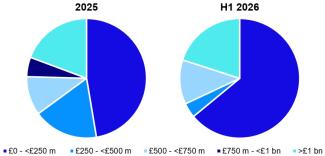
Fewer firm offers, but with a higher aggregate value compared with last year. There were fewer firm offers in H1 2026 (25) as compared with H1 2025 (37), but they had a higher aggregate value (approximately £35.4bn compared with £22.1bn in H1 2025) and a higher average value per firm offer (approximately £1.4bn compared with £597m in H1 2025). This was in large part due to the three firm offers valued at over £8bn (the largest firm offer in 2025 was valued at approximately £4.2bn). It continues to be the case that a large number of firm offers are valued at below £250m (64% in H1 2026), indicating that there may still be a preference among bidders for less risky, smaller deals, with AIM (which accounted for 40% of the firm offers in H1 2026) continuing to be a market providing value opportunities.
- Bid premiums went down slightly, but remain high in certain contexts. Bid premiums to the undisturbed share price were approximately 40% in H1 2026 (down from 49% in 2025), although premiums over 100% were offered in a couple of lower value deals.
- Increased interest from overseas bidders. Whilst UK and US bidders continue to be active, involved in approximately 28% and 24% of the firm offers in H1 2026 respectively, this is lower than in 2025 where 42% of firm offers involved UK bidders and 31% involved US bidders. This suggests that bidders from a wider range of overseas jurisdictions are becoming increasingly interested in acquiring UK assets, which continue to be viewed as undervalued. All five firm offers over £1bn were from overseas bidders, with US bidders involved in three of those offers.
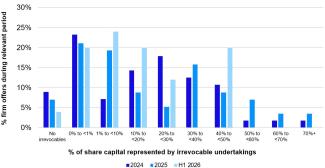
Firm offers continue to feature irrevocable undertakings. In H1 2026, irrevocable undertakings were typically given in respect of less than 10% and between 40% and 50% of the target’s issued share capital. Unlike in recent years, in H1 2026 no firm offer was supported by irrevocable undertakings in respect of over 50% of the target’s issued share capital.
- Cash is king. The number of cash-only bids in H1 2026 increased to 76%, continuing the recent upward trend (67% in 2025 and 62% in 2024). The remaining firm offers typically still involved cash in some form, either combined with listed securities (two firm offers) or an unlisted securities alternative (three firm offers). There was only one all-share firm offer.
- A higher number of deals involved some form of debt financing. 64% of firm offers in H1 2026 involved some form of debt financing (compared with 56% in 2025 and 48% in 2024). As in previous years, where cash consideration was not debt financed, it was funded from existing cash resources (usually strategic bidders) and equity subscriptions (usually PE bidders).
Continued use of tailored conditions to cover regulatory risk. H1 2026 confirmed that the UK’s regulatory environment has become more predictable procedurally without becoming significantly less interventionist for deals with UK-specific concerns.
The UK Competition and Markets Authority (CMA) continued to implement its pro-growth “4Ps” agenda through faster engagement, greater openness to efficiencies and a more flexible approach to remedies, while retaining a willingness to impose significant conditions where competition concerns persisted. Our client update discussing the CMA’s approach can be found here. Meanwhile, UK National Security and Investments (NSI) Act enforcement remained focused on genuinely strategic assets, with most interventions taking the form of targeted behavioral and governance remedies rather than outright prohibitions. The Cabinet Office published its annual report on NSI activity for 2025/26 on July 14, 2026, a copy of which can be found here.
Market practice remained to include conditions precedent to allow for completion of informal CMA briefing paper engagement and NSI mandatory notifications. In deals where no proactive engagement is envisioned, springing conditions precedent to cover off the risk of call-in and interim orders by the CMA and the Investment Security Unit remain commonplace.
- Shareholder approval of management incentivization arrangements continues to be rare. Private equity bidders continued to be willing to defer discussions and agreements on management incentive plans until after completion of an offer. Whilst two firm offers in H1 2026 disclosed management retention or incentivization arrangements that were subject to a “fair and reasonable” opinion under Rule 16, there were no firm offers requiring separate independent shareholder approval for special management incentivization arrangements (so-called “Rule 16 arrangements”). This continues the trend seen in recent years, with only one firm offer in 2025 and two firm offers in 2024 requiring such approval.
- Employee representative opinions remain uncommon. Consistent with recent years, employee representative opinions under Rule 25.9 were rare. Only one such opinion was provided in H1 2026, which focused on the potential employment-related and broader public interest implications of the transaction.
The analysis and commentary set out above is based on publicly available information relating to the 25 firm offers made for Main Market listed or AIM traded targets in the period January 1, 2026 to June 30, 2026 inclusive.
This communication, which we believe may be of interest to our clients and friends of the firm, is for general information only. It is not a full analysis of the matters presented and should not be relied upon as legal advice. This may be considered attorney advertising in some jurisdictions. Please refer to the firm’s privacy notice for further details.